
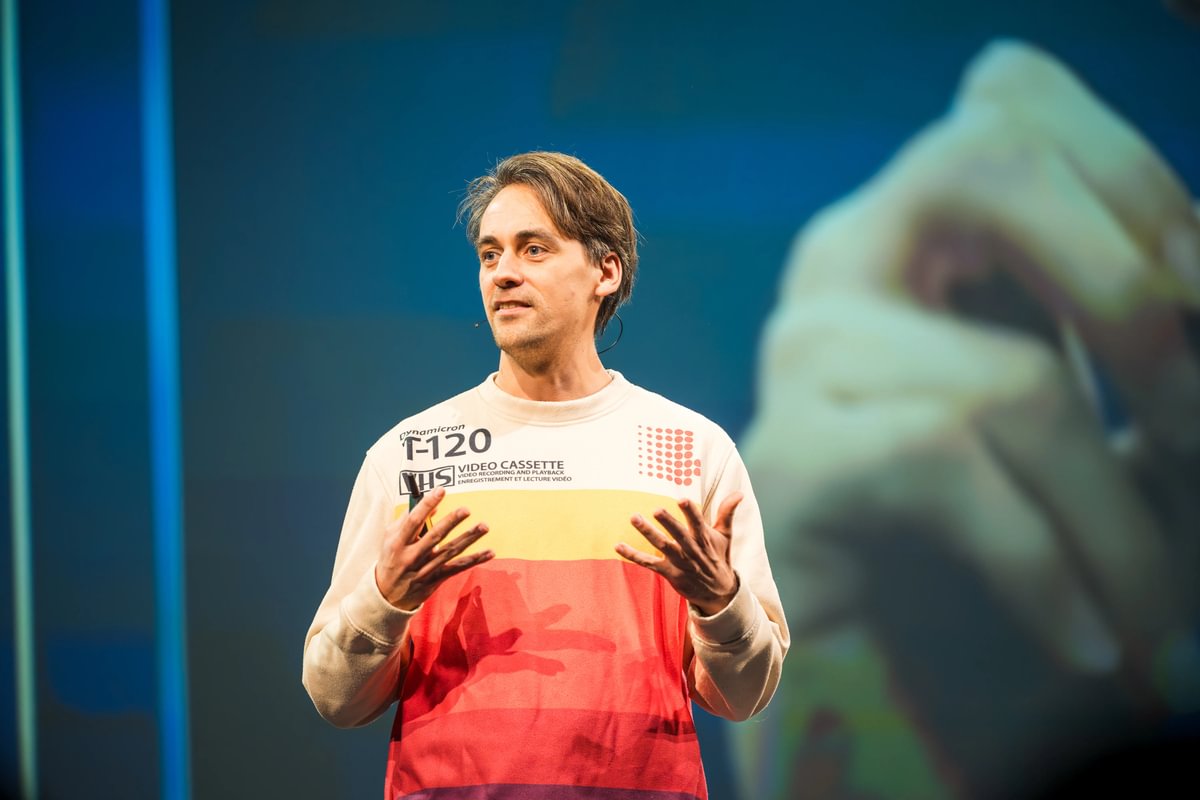

At the Marktlink Capital Investor Day, Alexander Klöpping spoke about the lightning-fast rise of AI - and what lies ahead as the models escape the chat window in the browser and go on to control all aspects of everyday life.
First, a disclaimer: this piece was written and corrected entirely by hand, without the intervention of Large Language Models. It is a report from the Marktlink Capital Investor Day where we had invited Alexander Klöpping as the tech expert of the Netherlands to update the investor community on the impact of AI.
For venture capital and the investor community members who are in venture funds, AI is particularly relevant, because looking at the reports of the past months it is clear that a large and growing part of the available pool of venture capital is flowing to AI companies. It is also a topic for private equity investors, as funds need to invest heavily to keep their portfolio companies relevant and competitive. Much of the infrastructure of the AI revolution is made possible by private markets, as the construction of all those data centers is largely funded by private credit.
The question, however, is whether there isn't a bubble. The last time so much was pumped into new tech infrastructure, we subsequently experienced a massive dotcom bubble and, looking at history, we haven't seen such a massive wave of investment since the railroad bubble of the 1840s.
So the "bears" are apprehensive about a bubble, but the "bulls" believe that AI is enabling such a productivity boom that it really doesn't matter that so much is being built now. What's a few hundred billion in misplaced investment on this entire industrial revolution, Mark Zuckerberg of Meta said recently, and there are plenty of experts who agree with him.
Aside from the bubble, there are bigger existential questions surrounding AI. Yet Klöpping doesn't venture into the big questions and big answers in his story: technology is moving too fast and development is too elusive for that. Still, he does have four propositions for the audience that he does venture. In a row:
1. AI will not continue to look like a chatbot.
By now ChatGPT's little screen with the "what can I help you with today?" is already fairly well established, but Klöpping shows a number of examples of AI outside the browser. Take, for example, the glasses from Meta (formerly Facebook) that allow AI to watch you in real time. There are also devices you can hang around your neck that record, summarize and analyze all your conversations throughout the day. This was less liked by Klöpping's girlfriend, by the way, when she claimed once after a disagreement, "I never said that" - the AI had really heard it anyway...
2. AI writes code to make the AI better.
Until now, we consider AI mainly as something that is created by handy software developers. But of course, what those software developers did directly is program the tools to take their own work off their hands. At some point, this will go so far that computers will be able to program themselves, so to speak. What happens then is hard to predict. Klöpping quoted figures here from Amazon and Google, where already more than 80% of internally delivered code has been created by AI.
Another nice aspect of this point is that such programming AI is all "new" to us in the room, but for the new generation a responsive computer, tablet or phone is quite normal. Klöpping talks about how his little daughter, along with some classmates, is already building her own apps for schoolwork. For example, she recently built an app in Loveable to practice the tables, including "high scores" for the fastest calculators. A little parenting tip from Klöpping: yes, she is allowed on the iPad, but only if she builds the apps herself. So a whole generation is growing up that knows no better than that computers are adaptive, which in turn raises the question of how long static apps will remain the big beasts of software.
3. Computers do half of your current work.
On this point, the room naturally pricked up its ears: entrepreneurs are especially curious to see what AI will do for productivity. Not only our own, but also those of employees. Klöpping himself gave the example of Excel - despite working in Excel for years as an entrepreneur, he never got really good at it, but now, by simply asking Chat questions and uploading screenshots, you can suddenly pretend to be very good with the spreadsheets.
Elsewhere on the day, people also asked how that works for investment funds. A book review that used to take about three days is now done in a few hours, purely because AI has already mastered a lot of data sorting tasks extremely well. We also briefly checked this claim with our own investment team and the analysts could indeed confirm this.
In short: many boring things (such as endless Excel tweaking) will soon be done for you by the computer. What should we do then? Well, says Klöpping, above all ask yourself what the added value of your work is, what drives you and what you like: mainly do those things and let the models take care of the rest.
4. Someone around you will have an intimate relationship with a synthetic being.
This was perhaps the most shocking point - that ChatGPT and related models are not only productivity tools, but also serve as a synthetic substitute for friendships and relationships. It is already the case, Klöpping said, that most use of ChatGPT consists of questions that. So it is only a matter of time before someone in your immediate circle falls in love with a chatbot.
YOLO
Above all, Klöpping emphasizes that after decades of dabbling, developments are now suddenly moving so fast that they can hardly be kept up with. Whereas in 2023 we thought a video in which an AI-generated version of Will Smith was raking spaghetti in a most unnatural way was quite impressive, now AI video is everywhere and barely distinguishable from the real thing. So the question is no longer how we are going to accelerate development, but whether we should not apply the brakes. He takes the example of an AI tool for software development that has a "YOLO slider" that allows you to set how far you want to go in developing your app. The sliding scale goes from tentative - generate only a little code - to YOLO (you only live once, internet slang for a reckless leap of faith) - complete the product immediately and publish it straight away. The question is how far society is willing to go. Here the battle seems to be primarily between the tech bosses who want to accelerate to the max and the officials, especially from the EU, who want to encapsulate AI with all sorts of standards and regulations.
By the end of the talk, the room was already pretty impressed with the current capacity of AI models. "But," said Klöpping, "the AI you are using today is the very worst AI you are ever going to use." There is undoubtedly a lot more to come.
The apps Alexander Klöpping uses in his daily life:
1. Claude.ai
The best app for writing.
2. Shortwave.ai
Works concise instructions into neat emails.
3. NotebookLM.google
Transforms long boring texts into a podcast conversation, responds to questions.
4. Lovable
Encodes apps based on written instructions. Incidentally, a portfolio company of Marktlink Capital through our venture capital funds.
5. Whispr Flow
Rewrites whispered stream-of-consciousness monologues into readable texts.
This article has already appeared in the December 2025 Marktlink Magazine.


